Bathory, Album by Album: From Black Metal to Viking Metal

In 1984 a teenager in Stockholm ran out of the letter C. He was spelling out song titles with rub-on lettering for his band's first album, so one track went out into the world as "Necromansy". That teenager was Quorthon, the band was Bathory, and the record that carried the misspelling became one of the founding documents of black metal.
If you have heard the name but never known where to begin, this guide walks through the Bathory catalogue era by era: what each stretch sounds like, which album to try first, and the pieces that celebrate it.
Who were Bathory?
Bathory formed in Vällingby, Stockholm, on 16 March 1983, and took its name from the Hungarian countess Elizabeth Báthory. The one constant member was Quorthon, born Thomas Börje Forsberg on 17 February 1966. At times he played every instrument himself.
Over about twenty years the band released twelve studio albums. Bathory ended in 2004, when Quorthon was found dead in his Stockholm apartment in June of that year, of a heart condition. What he left behind is a body of work that is credited with shaping two whole styles of heavy music: black metal and Viking metal.
Where does the black metal story start?
With the first four albums. The book Lords of Chaos called them "the blueprint for Scandinavian black metal", and they are still the records people reach for when they want to hear where it all began.
- Bathory (1984). Two sides, "Darkness" and "Evil", and songs like Hades, Reaper, Sacrifice and War. Quorthon produced it with The Boss, his father Börje Forsberg. The goat on the cover was meant to be gold; that cost too much, so it came out bright yellow, the famous "yellow goat", before switching to black and white after the first 1000 pressings.
- The Return...... (1985). Eleven songs, from Revelation of Doom to The Return of the Darkness and Evil.
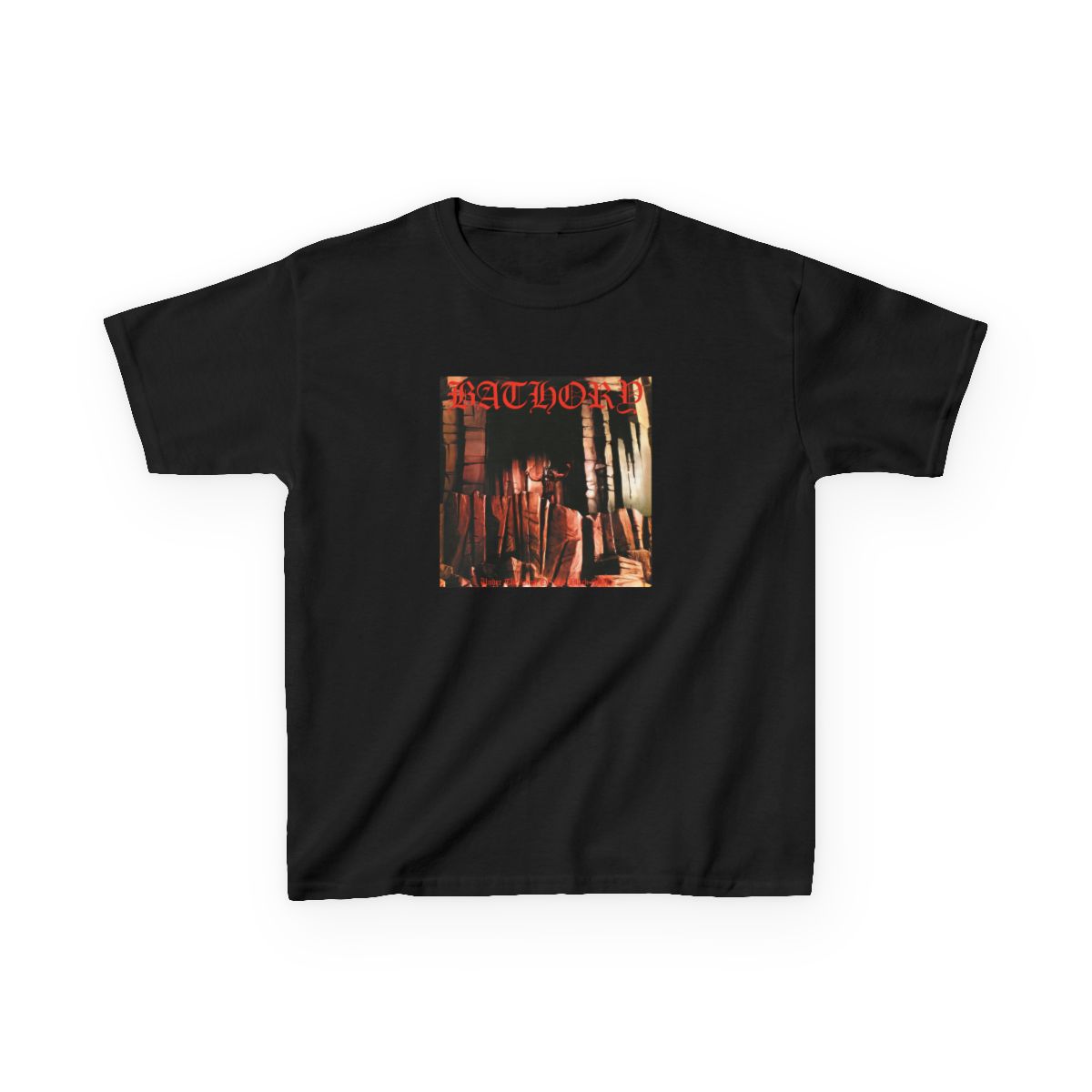
- Under the Sign of the Black Mark (1987). The cover shows a horned figure, photographed at the Royal Swedish Opera. In 2013 Decibel named it the top black metal album.
- Blood Fire Death (1988). The bridge between the two worlds (more on that below).
If you only try one, Under the Sign of the Black Mark is the obvious door in. It also makes a striking piece for a younger listener: the Under the Sign of the Black Mark kids tee carries that horned figure with raised arms between tall stone columns, under the red Bathory logo.
For the debut itself, the Goat Red Logo hoodie brings back the stark black-and-white goat from that first album, long curved horns and glowing red eyes, under a blood-red logo. It is the image most people picture when they hear the band's name.
How did Bathory end up inventing Viking metal?
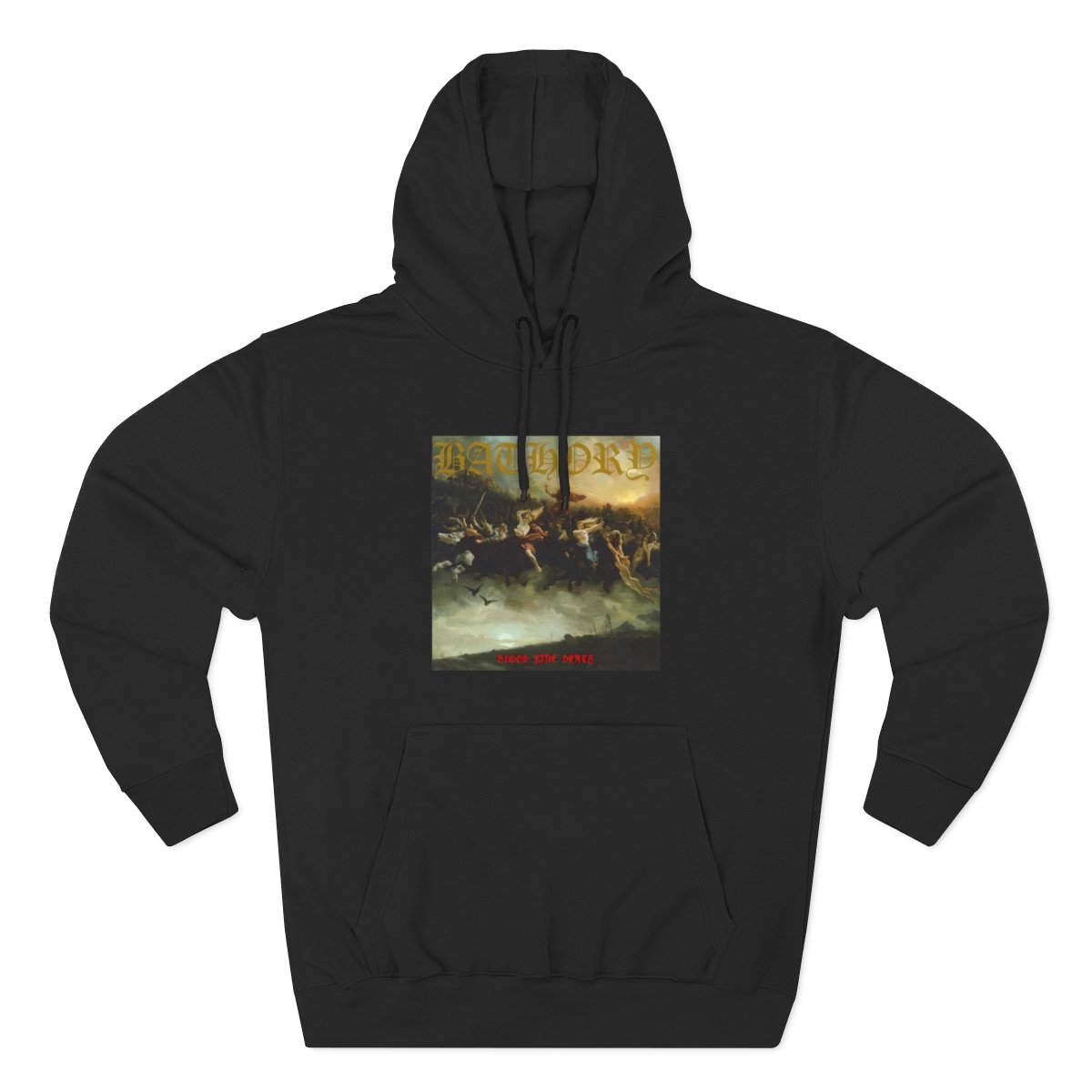
Blood Fire Death is where the turn begins. The 1988 album holds some of the first examples of what came to be called Viking metal, and its cover says it all: Peter Nicolai Arbo's 1872 painting The Wild Hunt of Odin, with riders charging through the clouds.
That painting is the centrepiece of the Blood Fire Death hoodie, under the gold Bathory logo. It suits anyone who loves the moment a band changes direction, and it reads as much like a piece of art history as a metal shirt.
Then came the records that made the new sound a style of its own:
- Hammerheart (1990). Its cover is Frank Dicksee's painting The Funeral of a Viking, and the album is counted as a cornerstone work of Viking metal.
- Twilight of the Gods (1991). Seven songs, including Blood and Iron, Under the Runes and Bond of Blood. It closes with "Hammerheart", a song based on Holst's Jupiter.
If epic, slow-building songs are more your thing than raw speed, start with Hammerheart. The Hammerheart hoodie carries the album's helmeted warrior raising his arm in fiery reds and golds, framed by the logo and runic lettering, a warm-toned piece that stands out from the black-and-white goats.
What about the later albums?
Bathory kept going through the 1990s and into the 2000s: Requiem (1994), Octagon (1995), Blood on Ice (1996), Destroyer of Worlds (2001), and finally the two Nordland albums, Nordland I (2002) and Nordland II (2003). Once you know the early records and the Viking era, these are the next step, and they round out the picture of a band that never stood still.
Which piece suits which listener?
A quick way to match the artwork to the person:
- The one who loves the raw early sound: the debut goat, on the Goat Red Logo hoodie, or the 1984 Goat hoodie with the Side Darkness and Side Evil songs inside a red pentagram.
- The one who plays the second album start to finish: The Return, with a pale moon glowing through dark clouds under an amber logo and all eleven songs listed. A young listener can wear it too, on The Return kids tee.
- The one who came in through the Viking era: Blood Fire Death, Hammerheart or Twilight of the Gods, with its snowy peaks under a burning red sky.
- The one who wants it simple: the plain white blackletter logo, nothing else.
Why Bathory still matters
Forty years on, the yellow goat, the horned figure from the opera house and the riders of the Wild Hunt are still some of the most recognisable images in heavy music. Bathory built two styles with a handful of records, mostly through one person's vision, and every one of those eras has a piece that wears it proudly. Pick the album that grabbed you first, and let the artwork tell the rest of the story.